Is a Known Traveler Number the Same as TSA PreCheck?
Short answer to "is known traveler number the same as tsa precheck": almost. TSA PreCheck is the program and the screening benefit. The Known Traveler Number (KTN) is the number that shows TSA you may use the PreCheck lanes. For Global Entry, NEXUS and SENTRI members the KTN is the CBP PASSID, so that number does get you PreCheck, but only after CBP approves you, and approval comes after the interview.
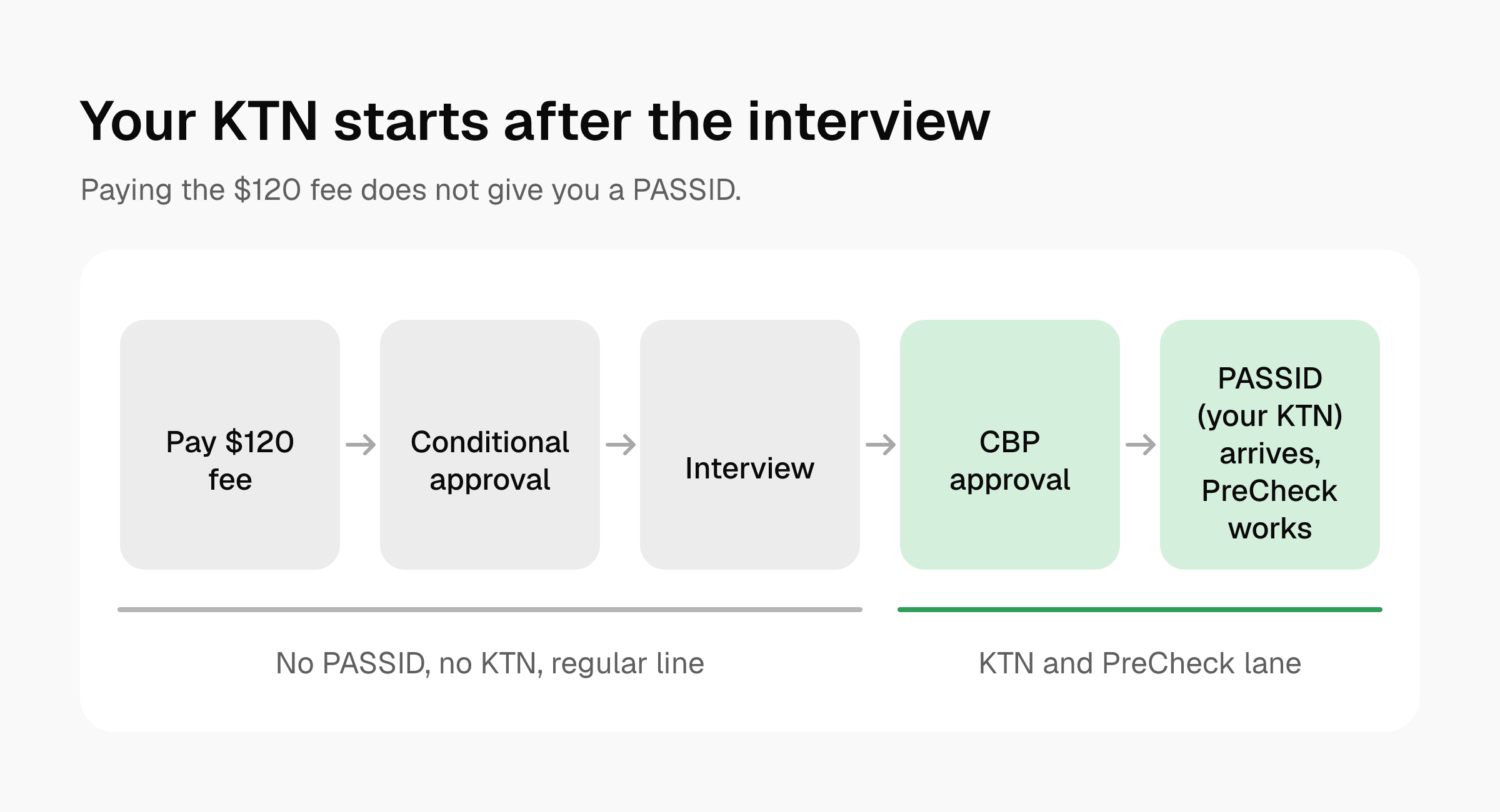
That timing is the catch for anyone with conditional approval. Until the interview is done, you have no PASSID, no KTN and no PreCheck lane. The interview backlog is what stands between you and the lane.
Why sources word it differently
Chase says a KTN is often called a "TSA PreCheck number" and is often interchangeable with it (Chase). TSA and The Points Guy are stricter: the KTN is the number, issued by DHS and not by an airline, and it shows TSA you may use the PreCheck lanes (The Points Guy). On a booking form, "KTN," "PASSID" and "PreCheck number" all go in the same field.
Where the number comes from
The TSA PreCheck FAQ says a KTN is issued to everyone approved for PreCheck. How you get one depends on the program:
- TSA PreCheck application program: you get a KTN when TSA approves you.
- Global Entry, NEXUS or SENTRI: the KTN is your CBP PASSID. It is assigned after the interview and approval (The Points Guy).
Chase says the number usually shows in your online portal as soon as approval arrives, while the mailed letter can take several days. Approval may also come by email.
What the numbers look like
Per the TSA PreCheck FAQ:
- A PreCheck-only KTN is 9 characters, can mix letters and numbers, and usually starts with TT.
- A Global Entry, NEXUS or SENTRI PASSID is 9 digits, usually starts with 15, 98 or 99, and is printed on the back of the card.
Sources differ at the edges. Capital One's Known Traveler Number page lists a wider set of PASSID prefixes and says PreCheck KTNs can be 9 or 10 characters. If your number does not match the pattern above, check it against your approval notice or card before assuming it is wrong.
Who can get which number
Eligibility differs by program, per Capital One:
| Program | Who can apply |
|---|---|
| TSA PreCheck | U.S. citizens, U.S. nationals and lawful permanent residents only |
| Global Entry | U.S. citizens, lawful permanent residents and select foreign nationals |
| NEXUS | U.S. and Canadian citizens and permanent residents, plus Mexican nationals |
| SENTRI | U.S. citizens, lawful permanent residents and all foreign nationals |
Is known traveler number the same as TSA PreCheck for Global Entry members?
For members, the number does the same job. Global Entry includes TSA PreCheck, and eligible NEXUS and SENTRI members get it too. You do not need a separate PreCheck enrollment if you hold one of these.
There is no PreCheck card (TSA). Showing a Global Entry, NEXUS or SENTRI card at the checkpoint does not get you into the PreCheck lane. Two things have to happen:
- Your KTN or PASSID is in the KTN field of the airline reservation.
- The PreCheck indicator prints on your boarding pass.
Your KTN does not exist until the interview is done
You are assigned a KTN once you complete the interview and are approved. Paying the $120 fee and getting conditional approval does not give you a PASSID. Until then, every flight goes through the regular line.
What each number costs
Fees as of November 2026:
- Global Entry, NEXUS and SENTRI: $120 each for 5 years. Global Entry was $100 before October 1, 2024.
- Standalone TSA PreCheck: $78–$85 for 5 years, depending on the enrollment provider. The TSA FAQ says the fee is $85 and "remains $85 presently." The Points Guy and Upgraded Points still show $78, so older articles may quote the lower figure.
TSA says first-time PreCheck applicants must pay in person at an enrollment center. The fee cannot be waived for a disability or medical condition. TSA accepts a credit card, debit card, money order, company check, or certified or cashier's check.
Worked example: counting the months without PreCheck
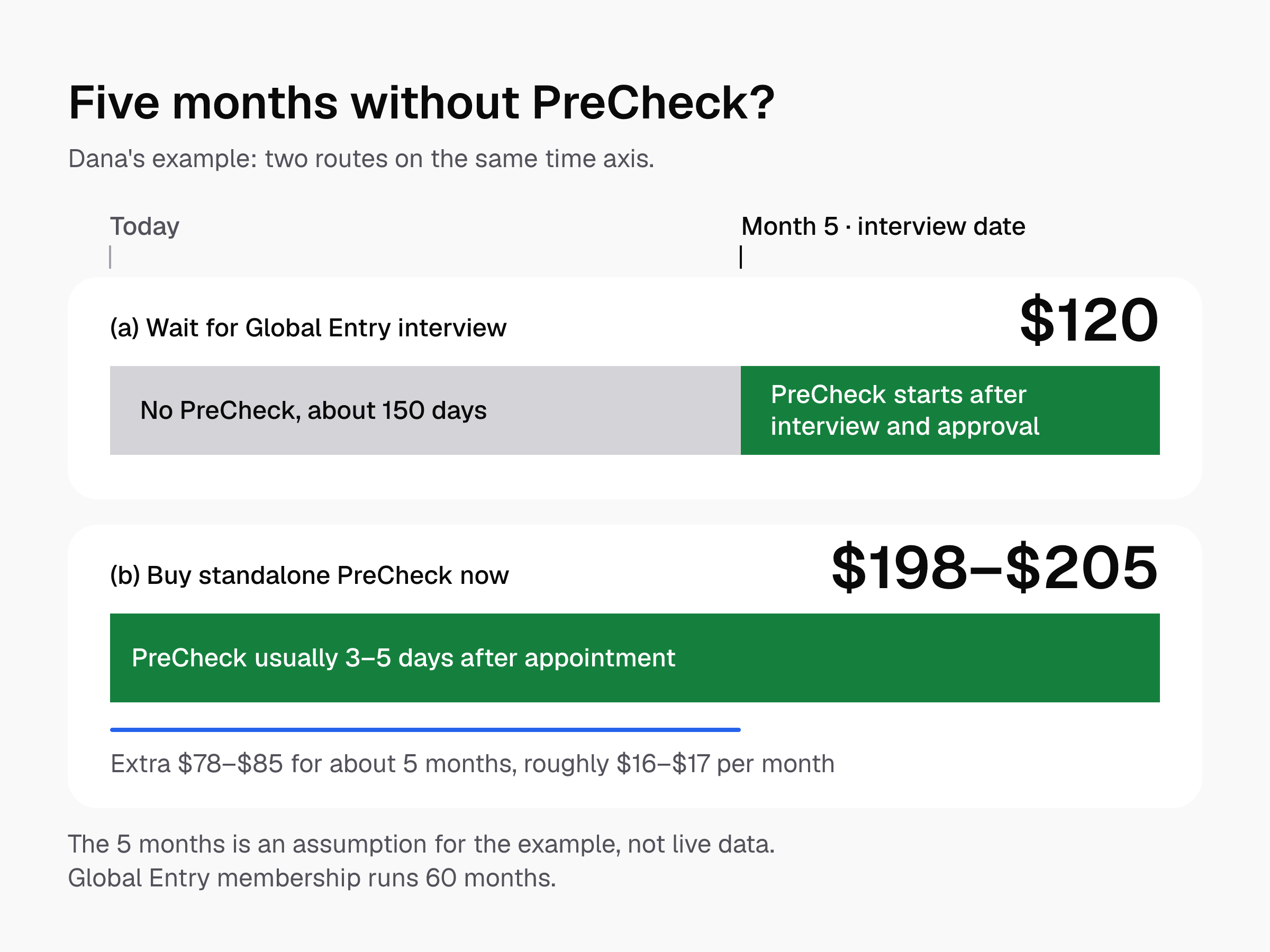
Worked example: Dana has conditional approval for Global Entry and needs an interview. She checks Global Entry appointment availability for the next bookable date at her center. For this example, assume that date is 5 months away. These numbers are an assumption for illustration, not live data for any center. Your center's date will differ.
- Five months is about 150 days of flying with no PreCheck.
- Her PASSID arrives only after the interview and approval, so the clock on her PreCheck benefit starts after those 5 months.
She has three routes:
| Route | What you pay | When PreCheck starts | Catch |
|---|---|---|---|
| (a) Wait for the Global Entry interview | $120 | After the interview and approval, about 5 months in this example | No PreCheck until then |
| (b) Buy standalone PreCheck now, then still do Global Entry | $198–$205 in total ($78–$85 plus $120) | Usually 3–5 days after the PreCheck appointment | Two numbers to track; PreCheck does nothing at customs |
| (c) Finish at Enrollment on Arrival | $120 | On the first international trip home through a participating airport | Depends on when you next fly abroad and land at one of those airports |
Route (b) math. The extra $78–$85 buys early PreCheck for about 5 months in this example. That works out to roughly $16–$17 per month of early access (for instance, $85 divided by 5 months is $17). The rest of that PreCheck membership overlaps with Global Entry, which already includes PreCheck. If you buy both, expect to keep two numbers straight on your bookings.
Route (c). Enrollment on Arrival lets you finish the Global Entry interview when you return from an international trip, at participating airports. It only helps if you have a trip abroad coming up.
The $120 fee after a card credit
Some cards reimburse the fee. Capital One Venture and Venture X reimburse the PreCheck or Global Entry fee once per account every 4 years. Chase Sapphire Reserve gives up to $120 every four years. The Capital One Venture Rewards card gives up to $120, per Upgraded Points. Card terms change, so confirm yours before you count on one.
Say Dana's card credits up to $120 once every 4 years:
- Route (a): $120 fee minus $120 credit is $0 net. She still waits the same 5 months.
- Route (b): $198–$205 in fees minus one $120 credit is $78–$85 net, because the credit is used once.
The credit lowers the price. It does not shorten the interview wait.
How to get your own number
- Open Global Entry wait times and find your center. NEXUS and SENTRI have their own wait-time pages for their centers.
- Check Global Entry appointment availability for each center's next bookable date.
- Count the months from today to that date. Multiply by $16–$17 to see the price of route (b)'s bridge.
The availability page shows the next bookable date. It does not show whether a slot is open right now.
Global Entry or PreCheck alone?
TSA suggests considering Global Entry if you fly internationally two or more times a year. The Points Guy calls it probably the best value for multiple international trips in five years. Global Entry adds the customs benefit for about $35–$42 more than standalone PreCheck over 5 years ($120 minus $85, or minus $78). Run your own trip count in the cost per trip calculator.
PreCheck is offered at over 290 U.S. airports with more than 85 airlines, per Capital One. You can fly domestically and internationally without a KTN. You just use the regular line.
Standalone PreCheck takes about 5 minutes online and about 10 minutes at an in-person appointment. Most people get a KTN in 3–5 days, though TSA says it can take up to 60 days. If your Global Entry interview is under a week away, route (b) is not worth it. If it is months away and you fly often, the math above decides it.
How to enter your KTN
- Put it in the KTN field when you book online, by phone or through a travel agent. You can add it at checkout.
- Add it to your frequent-flyer profile. The Points Guy says it should then apply automatically to every booking with that airline.
- You can add it after booking too. Add it online before check-in if you can.
- Confirm the PreCheck indicator prints on your boarding pass.
My KTN isn't working: a checklist
- Typo: an incorrectly entered number is a common cause, per Upgraded Points.
- Name mismatch: the name on the reservation must exactly match the name on your application. Check date of birth too.
- Expired membership: TSA says an expired KTN gets no PreCheck indicator. A flight booked before your KTN expires but flown after it expires will not get PreCheck.
- Airline: it must participate in PreCheck.
- Card in hand: a Global Entry, NEXUS or SENTRI card alone does not open the lane.
Do I need to carry the card?
Upgraded Points says most travelers do not need the Global Entry card to use PreCheck or Global Entry lanes. Some have been asked for it, most often at preclearance airports (especially flights from Canada) and in NEXUS or SENTRI car lanes. Returning from Canada, Global Entry lanes require the physical card. TSA's rule still stands: the card does not open PreCheck lanes.
Lost or forgotten number
- Global Entry, NEXUS or SENTRI: log on to the Trusted Traveler Program website to see your PASSID (TSA). Upgraded Points says this works for a lost card too. The find your known traveler number guide has the steps.
- PreCheck application program: use TSA's KTN lookup page.
- Other places: Chase also lists your approval letter and your TSA PreCheck online account.
Official sites only
TSA recommends enrolling only through universalenroll.dhs.gov to avoid unexpected extra fees. Any site that offers PreCheck registration and does not end in .gov is not an official TSA PreCheck site.
Renewal and other routes to PreCheck
- PreCheck members can renew online up to 6 months before expiry. TSA recommends renewing at least 60 days before.
- Members get reminders at 6 months, 3 months, 1 month and 2 weeks, and keep the same KTN.
- PreCheck can also come through HME, TWIC, DoD or DHS employee programs. Each has its own TSA info page.
Kids and military
- Children 12 and under can use the lane with an enrolled parent.
- Ages 13–17 need the indicator on their own boarding pass and must be on the same reservation.
- Anyone 18 or older needs their own KTN.
- Military members can use their DoD ID number as the KTN. Showing a CAC does not work.
Getting the PASSID sooner
The only way to move your KTN date up is an earlier interview. GlobalEntryTexts texts you when a Global Entry, NEXUS or SENTRI interview appointment opens at the enrollment centers you choose. It costs $25, paid once, for 30 days of monitoring, and it is not a subscription. You can watch up to 3 centers for that price. You book the slot yourself on ttp.dhs.gov.
FAQ
Frequently Asked Questions
No. You can fly domestically and internationally without one, per Capital One. You go through regular screening instead of the PreCheck lane.
Yes. It can be added to a booking after the fact, even at the check-in desk. Upgraded Points recommends adding it online before check-in so the indicator is ready on your boarding pass.
Usually not. Capital One reimburses the PreCheck or Global Entry fee once per account every 4 years, and Chase Sapphire Reserve gives up to $120 every four years. Check your card's terms before you apply for both.
Sources
- TSA PreCheck® FAQ
- I forgot my Known Traveler Number (KTN). How do I find it?
- Will I receive an ID card or other credential to use TSA PreCheck® lanes?
- Known Traveler Number program: What to know and how to apply - The Points Guy
- Known Traveler Number (KTN): What to know
- Known Traveler Number: Here's What You Need To Know [2026]
- How to Find Your TSA PreCheck® Number