How Do I Get a Redress Number? Free DHS TRIP Steps and Timeline
Apply for a redress number free through the DHS Traveler Redress Inquiry Program (DHS TRIP) at trip.dhs.gov. Most travelers don't have one and don't need one. If you searched "how do i get a redress number" because you keep landing in secondary screening while you wait on a Global Entry, NEXUS or SENTRI interview, the two processes are separate, and you can run them at the same time.
What a redress number costs and who should apply
The DHS TRIP application costs $0. You can complete it on a computer or a phone.
Apply if you are frequently referred for additional screening at an airport, or repeatedly sent to secondary screening at a CBP checkpoint. DHS TRIP does not handle customer-service complaints, discrimination issues, lost or damaged items, or help during a security screening.
The redress number does not guarantee you will never get extra screening. It makes extra screening less likely if you were previously falsely matched to a watchlist. It is optional: you do not need it to book a flight or to travel, and booking sites that ask for it can be left blank if you have none.
Worked example: a Global Entry applicant stuck in secondary
Worked example (an illustration, not a real traveler): Dana is applying for Global Entry. On 4 of her last 6 flights she was pulled for additional screening, and she has an international trip coming up. She has two problems, and they run on different clocks.
| Track | Cost | Where it happens | Timing |
|---|---|---|---|
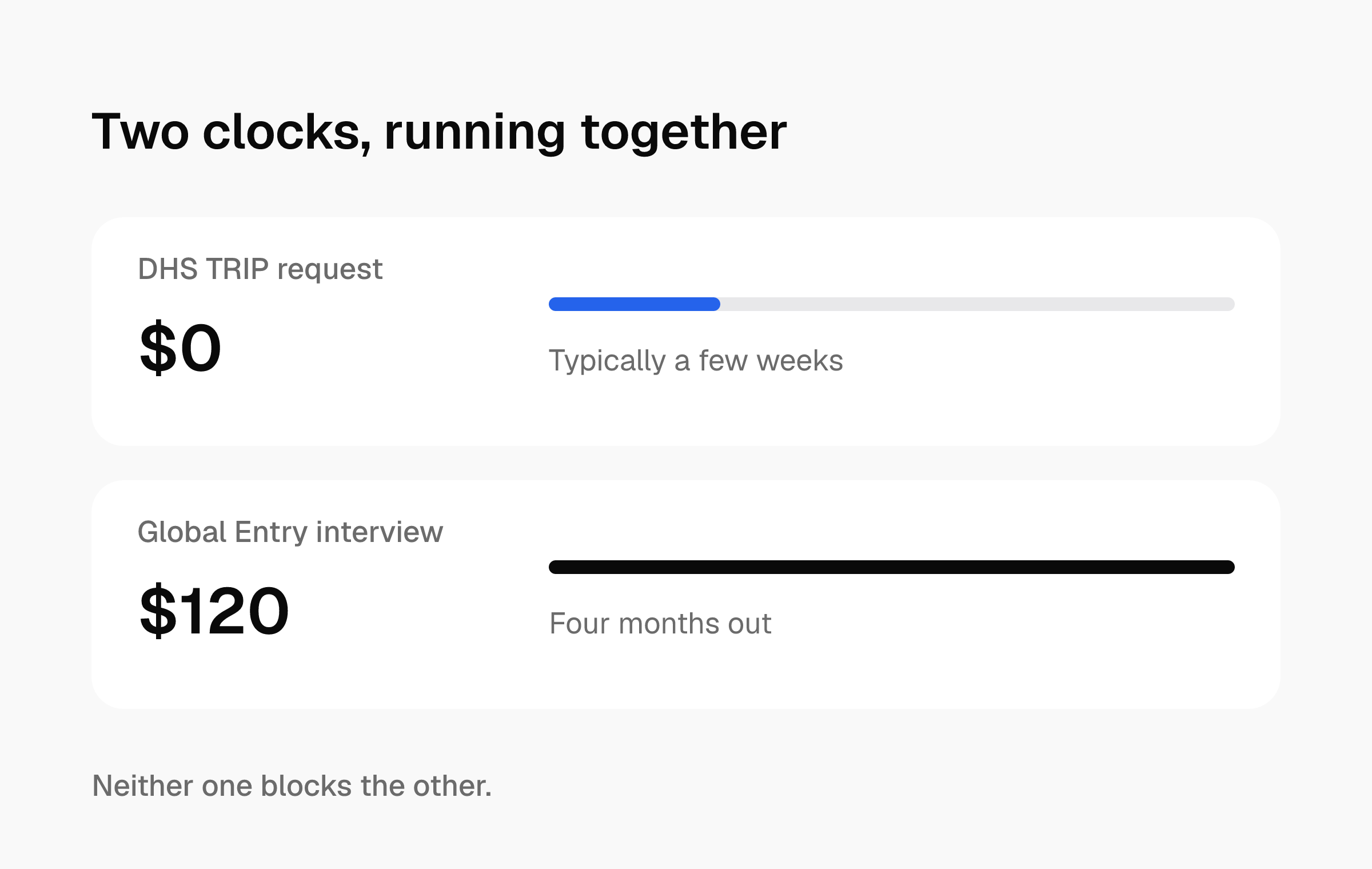
| DHS TRIP redress request | $0 | trip.dhs.gov | No fixed time published; one source says typically a few weeks |
| Global Entry application and interview | $120 CBP fee | ttp.dhs.gov | Depends on the next bookable interview date at the center |
Dana files the DHS TRIP request first, because it is free and takes one sitting. The same day she checks the interview side. The Global Entry wait times page and the appointment availability page show each center's next bookable date. If she were applying for NEXUS or SENTRI, the NEXUS wait times and SENTRI wait times pages do the same job. Each date shown is the next bookable date at that center, and cancellations never show up on a page.
Say Dana sees a next bookable date four months out. Waiting on that date does not stop her redress case, and the redress case does not hold up the interview. One more limit applies: Global Entry and PreCheck won't prevent secondary screening if Secure Flight flags a name, so the redress request is the tool aimed at that problem.
"how do i get a redress number": the steps
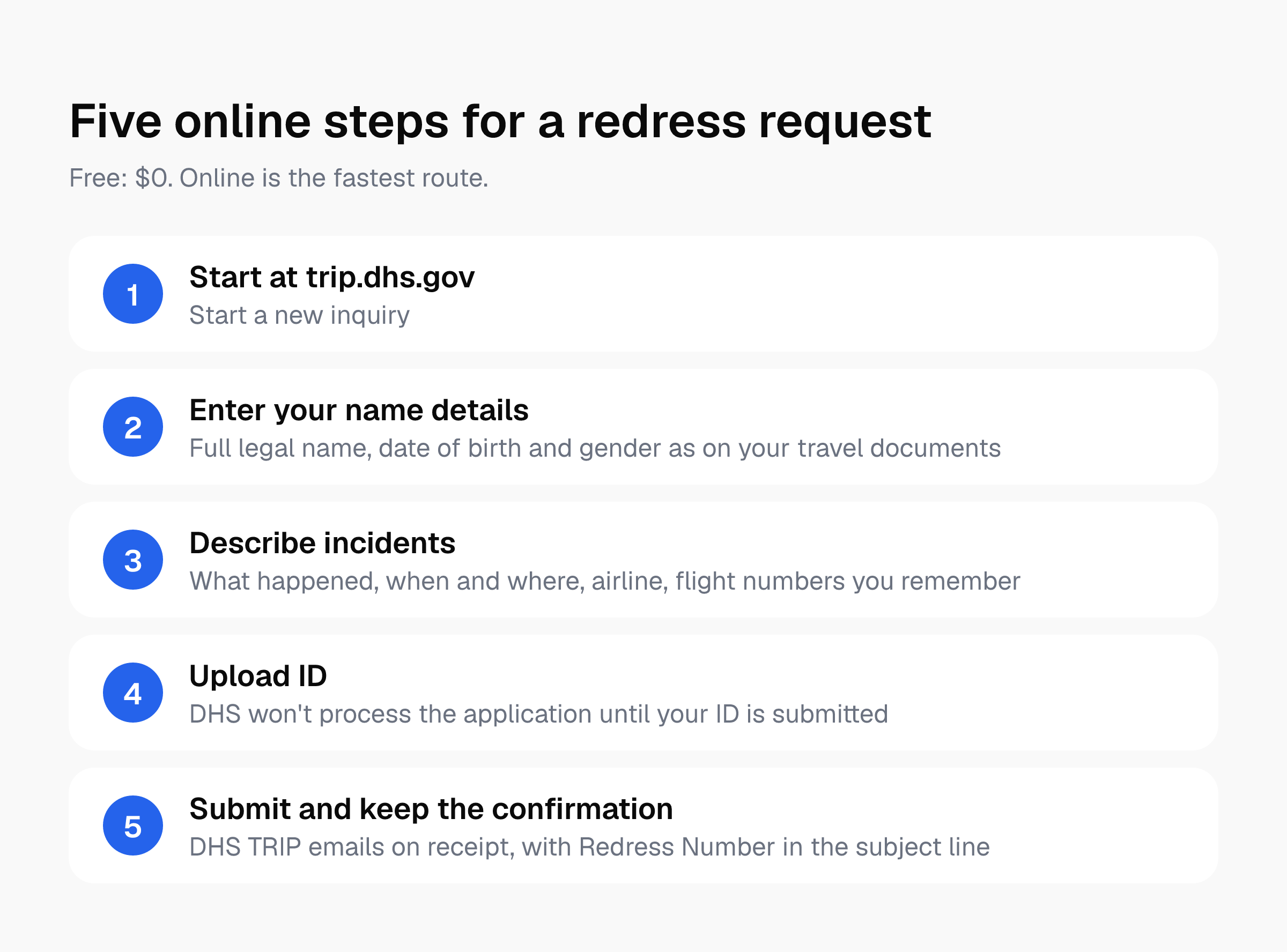
Online is the fastest route. Emailed or mailed applications are processed more slowly, and they must be signed and dated or they can't be processed.
- Go to trip.dhs.gov and start a new inquiry.
- Enter your full legal name, date of birth and gender exactly as they appear on your travel documents.
- Describe what happened: the incidents, when and where they occurred, which airline, and any flight numbers you remember. Flight details aren't required, but they help DHS TRIP process the request.
- Upload your ID (see the next section).
- Submit, and keep the confirmation. DHS TRIP emails on receipt with the Redress Number in the subject line.
You need a separate application for each person having difficulties. A parent or guardian can apply for a minor.
The 8-step paper form
If you use the paper application, it has 8 steps. Step 4 asks for full name, birthdate, birthplace, gender, height, weight, hair color, eye color and whether you are a U.S. person. Step 2 (privacy incidents) applies only if you felt your privacy was violated. You can name an attorney or representative in Step 6 using DHS Form 590.
Documents DHS TRIP wants
DHS won't process the application until your ID is submitted.
- U.S. citizens: the biographical page of an unexpired passport. Without a passport, an unexpired government photo ID such as a driver's license.
- Minors: a birth certificate may be sent.
- Non-U.S. citizens: an unexpired passport page and/or other U.S. government ID.
- Trusted Traveler cards: the SENTRI, NEXUS and Global Entry cards are listed as accepted IDs.
Do not send Social Security cards, tax information or personal financial documents.
How long it takes and what you get back
DHS publishes no fixed processing time. One source says typically a few weeks, so apply well before major trips. Track your case in the same portal. If the status says it requires more information, respond promptly or the case won't move. DHS doesn't penalize a second application.
DHS sends a resolution letter detailing the result. The redress number arrives by email or postal mail. If the resolution seems wrong, follow the instructions in the letter.
Redress number, Known Traveler Number and PASSID are three different things
The redress number is 7 digits. A Known Traveler Number is 9 digits per FedLaws. DHS says the two are not interchangeable, and the PASSID is a separate identifier from the redress number as well. For the detail on which box takes which number, see Redress Number vs Known Traveler Number.
| Number | Digits | Comes from | Where it goes |
|---|---|---|---|
| Redress number | 7 | DHS TRIP | Redress Number field in your TTP profile; airline profile |
| Known Traveler Number | 9 (per FedLaws) | Your Trusted Traveler membership | Known Traveler Number field on bookings |
Where to enter the redress number
- TTP profile: enter it in the Redress Number field, as the seven-digit number exactly as written in the DHS TRIP communication. It is not printed on the Global Entry card, so keep the email or letter.
- Airline profile: add it to your frequent-flyer profile and it attaches automatically to bookings.
After you have the number
A name change, new passport or move doesn't need a new number. Email legible updated documents with your Redress Control Number to TRIP@tsa.dhs.gov. One source gives a different DHS address for submissions, so use the portal and confirm the address on the DHS TRIP site. DHS lists no expiration or renewal for the number.
Use the waiting time on the interview side
The redress request costs $0, and the Trusted Traveler application costs $120 for Global Entry, NEXUS and SENTRI alike, each membership lasting 5 years. The interview wait is usually the longer clock.
GlobalEntryTexts texts you when a Global Entry, NEXUS or SENTRI interview appointment opens at the enrollment centers you choose. It costs $25, paid once, for 30 days of monitoring. It is not a subscription. You book the appointment yourself on ttp.dhs.gov, since GlobalEntryTexts never books for you, because auto-booking would break the Trusted Traveler Program's terms. You can run it while your redress case is pending, and nobody can promise you a slot.
FAQ
Frequently Asked Questions
Yes. A parent or guardian can apply for a minor. Each person having difficulties needs a separate application, and a minor may send a birth certificate as ID.
No. A name change, new passport or move doesn't need a new number. Send legible updated documents with your Redress Control Number, and confirm the current submission address on the DHS TRIP site.
Respond promptly. The case won't move until you do. DHS doesn't penalize a second application, and you can track the case in the same portal.
No. It is optional, and booking sites that ask for it can be left blank if you have none.