Redress Number vs Known Traveler Number: Which Box Is Yours?
If you are asking is redress number same as tsa precheck, the answer is no. A Known Traveler Number (KTN) is a membership number that puts the TSA PreCheck indicator on your boarding pass. A redress number is a 7-digit DHS TRIP case number (the Redress Control Number) for travelers who keep getting misidentified or sent to extra screening. They go in separate boxes on the booking form, and neither can stand in for the other.
If you are waiting on Global Entry, NEXUS or SENTRI, your KTN is the 9-digit CBP PASSID on your card. A redress number does nothing to speed that up. The rest of this page shows what each number is, why misidentification happens, and then walks through a dated example of the two clocks: the interview wait for your PASSID and the DHS review for your redress number.
Quick answer: is redress number same as tsa precheck?
No. PreCheck status comes from a KTN. Redress is a case file with DHS that tries to stop you being mistaken for someone else. Having one does not put you in a PreCheck lane, and having the other does not clear up a name mix-up.
Most travelers have neither number. Neither is required to book or fly, so a blank field is fine. Fill in a box only if you have that number.
Redress number vs known traveler: which box do you fill in?
| Known Traveler Number (KTN) | Redress number | |
|---|---|---|
| What it does | Prints the PreCheck indicator on your boarding pass | Links your booking to your DHS TRIP case so you are less likely to be mistaken for someone else |
| Length | 9 digits for Global Entry, NEXUS and SENTRI (the CBP PASSID); 9 or 10 characters, letters allowed, for TSA PreCheck Application Program members | 7 digits |
| What it looks like | PASSID usually starts with 10, 13, 14, 15, 16, 50, 70, 80, 95, 98 or 99; PreCheck Application Program numbers start with TT, TE or AC | Digits only |
| Cost | Global Entry, NEXUS or SENTRI: $120 for 5 years. TSA PreCheck: $78 to $85 for 5 years, depending on the enrollment provider | Free |
| How you get it | Apply, get conditional approval, then complete an in-person interview | Submit the DHS TRIP Traveler Inquiry Form online |
| When you can use it | After you have the card or PASSID | After DHS finishes your review |
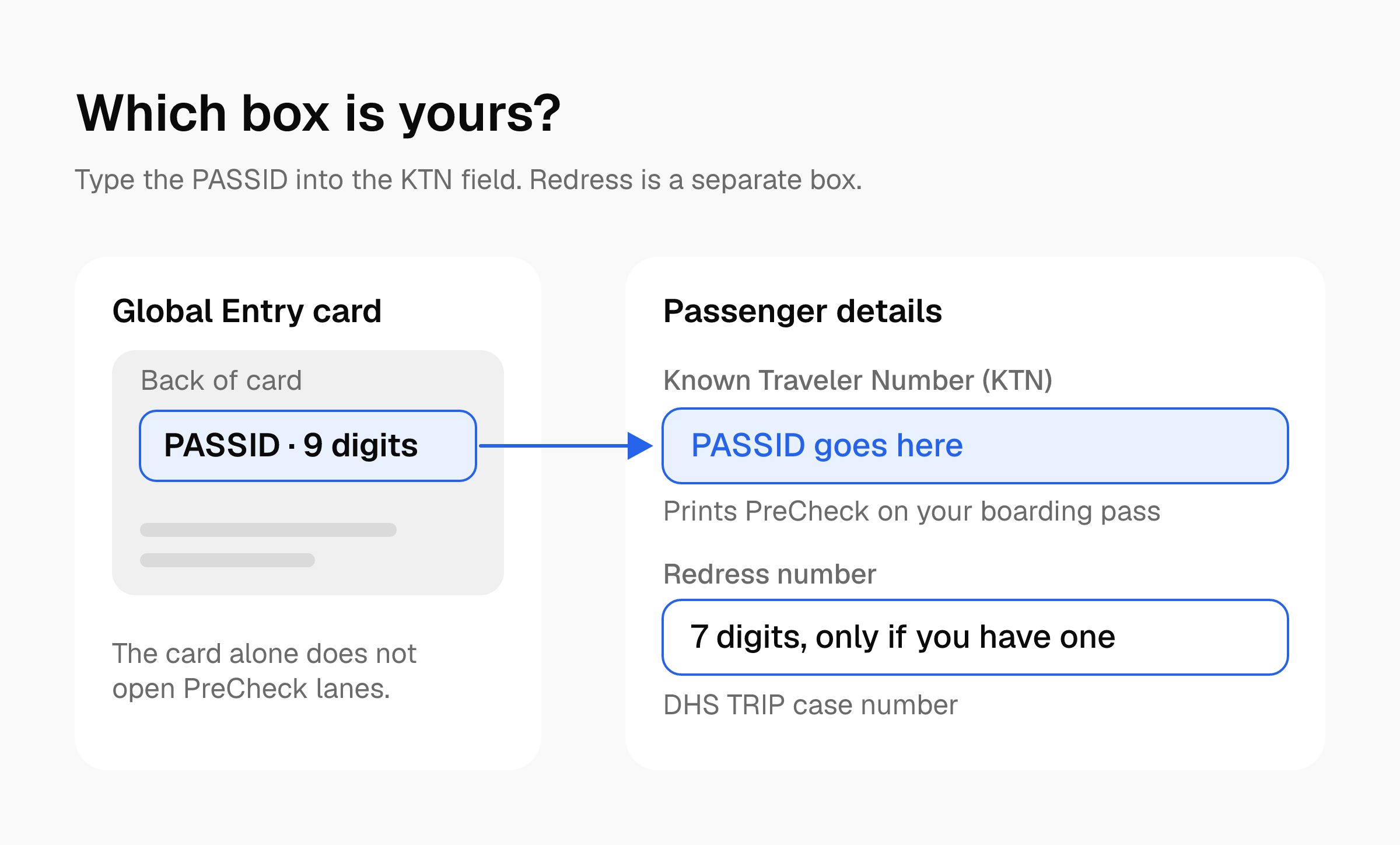
The Global Entry, NEXUS or SENTRI card itself does not get you into PreCheck lanes. You have to type the PASSID into the KTN field. If you entered it correctly, you will see a PreCheck logo with a green check mark on the boarding pass. TSA's pages say a PASSID usually starts with 98 in one place and list a longer set of prefixes in another, so use the prefix as a rough check only.
For a full explanation of the KTN side, see Is a Known Traveler Number the Same as TSA PreCheck?.
Which KTN source suits you?
The KTN column covers several routes, and each has a real strength.
- Global Entry, NEXUS or SENTRI: one $120 fee for 5 years gives you a PASSID that goes in the KTN box. A NEXUS or SENTRI member who crosses the border by land or air already holds a number that works for PreCheck, so no separate PreCheck enrollment is needed.
- TSA PreCheck Application Program (TT, TE or AC numbers): the fee is $78 to $85 for 5 years, which is $35 to $42 less than $120. It is the cheaper route if PreCheck lanes are all you want, and the price depends on which enrollment provider you use.
The trade-off for the CBP programs is the interview wait. The trade-off for the PreCheck Application Program is that the number covers PreCheck only.
Why do travelers get misidentified in the first place?
Secure Flight, the system that screens passenger names before boarding, can match your name to someone on a watchlist because the names are similar. DHS says 98% of redress applicants have no nexus to the terrorist watchlist.
The government neither confirms nor denies whether you are on a watchlist, except in very limited No Fly cases. Two facts are useful:
- If you were issued a boarding pass, you are not on the No Fly list.
- Selectee-list travelers get extra screening before boarding. That is the usual source of "SSSS" printed on a pass.
Does a redress number guarantee faster screening?
No. Using a redress number can reduce the chance of SSSS and secondary screening. It gives you no PreCheck lane access. DHS also says that even after your redress case is complete, you can still be selected for enhanced screening for various reasons or at random.
The reverse holds too. Global Entry and TSA PreCheck will not prevent secondary screening if Secure Flight flags your name. A KTN buys you lane access. Redress works on name matching. They solve different problems.
Who actually needs a redress number, and what does DHS TRIP cover?
DHS TRIP covers being repeatedly referred to secondary screening when clearing U.S. Customs, and repeated secondary screening more generally. It is not for mishandled bags or poor customer service. If you have seen "SSSS" on boarding passes more than once, or keep being pulled aside, it is worth a look. If you have seen it once, probably not.
You do not need to be in Global Entry or any trusted traveler program to apply for redress.
How the redress number works
- Assigned at submission. The number is assigned automatically when you submit the Traveler Inquiry Form, and it is used to track your status. It is 7 digits.
- Emailed. The confirmation email carries it in the subject line.
- Not usable yet. You cannot use it for reservations until DHS finishes the review.
- Shown late. The TRIP portal shows the number only after the case is closed.
- Free. Applying costs nothing.
DHS gives no fixed review time. Plan on waiting and do not count on a date. For the full application walk-through, see How Do I Get a Redress Number?.
What to submit
The online form has eight steps. Flight details are not required but help. Step 4 asks for:
- Full name, birthdate and birthplace
- Gender, height, weight, hair color and eye color
- U.S. person status
A passport, or a Global Entry, NEXUS or SENTRI card, can serve as your photo ID. Do not send Social Security cards or tax or financial documents. Online is processed faster than email or mail. Emailed or mailed forms must be signed and dated.
If you lose your redress number
You do not need to reapply. Email TRIP@tsa.dhs.gov with your full name, date of birth, gender, and city and state of residence. DHS publishes no turnaround time for recovery requests. Other places it may appear: your determination letter, the trip.dhs.gov portal (sign-in is now through Login.gov), and a saved airline profile.
Where to enter each number
Airline systems have separate Redress Number and KTN fields, and a number saved in the wrong field will not work. A PASSID in the redress box or a redress number in the KTN box does nothing. You can save either number in a frequent-flyer profile so it fills in automatically on later bookings.
Does a redress number speed up Global Entry, NEXUS or SENTRI?
No. They are separate systems. A redress number does nothing for PreCheck and nothing for your interview wait. Applying for one will not move you up any line.
Worked example: two tracks, two clocks
The traveler here gets SSSS often and is also waiting on Global Entry. Every day count below is made up so the arithmetic is easy to follow. Swap in the dates from the live pages.
Track 1: the KTN (PASSID)
- Day 0: you apply and pay the $120 CBP fee (the fee since October 1, 2024; each membership lasts 5 years).
- Example day 14: you get conditional approval, which lets you schedule an interview. Real timing varies.
- Interview date: this is the long wait. Open /global-entry-appointment-availability, find your center, and read its next bookable date. For NEXUS or SENTRI, use /nexus-wait-times or /sentri-wait-times.
- After the interview: the card, with the PASSID, follows. Until then the KTN box stays blank.
Track 2: the redress number
- Day 0: you submit the DHS TRIP form. The number is assigned now, but you cannot book with it yet.
- Example day 60: DHS closes the case. Only from here can the number go on bookings. DHS publishes no fixed time, so 60 is a placeholder.
Suppose your center's next bookable date is 95 days away. The interview lands around day 109, and the earliest realistic day for a PASSID is on or after that. In this example the redress number is usable about 49 days before the PASSID exists.
| Track | What starts the clock | Example day it is usable | Can you shorten it? |
|---|---|---|---|
| KTN (PASSID) | Interview date | Day 109 or later | Yes, by getting an earlier interview slot |
| Redress number | DHS closing your case | Day 60 (placeholder) | No |
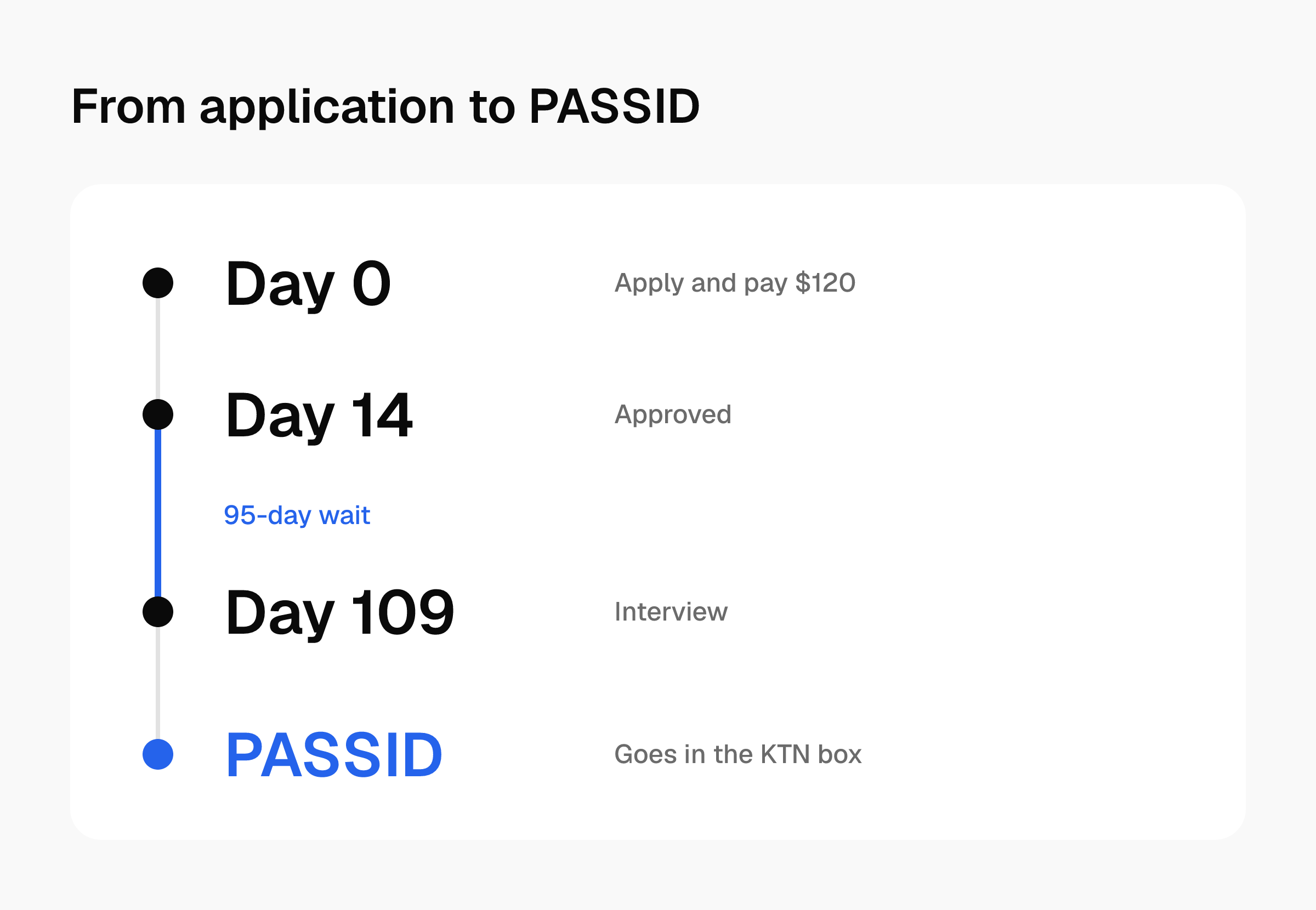
Only the interview wait is something you can shorten. If you caught an interview 30 days out instead of 95, the interview would fall around day 44 in this example, and the PASSID would exist 65 days sooner.
How much does the center you pick move that date?
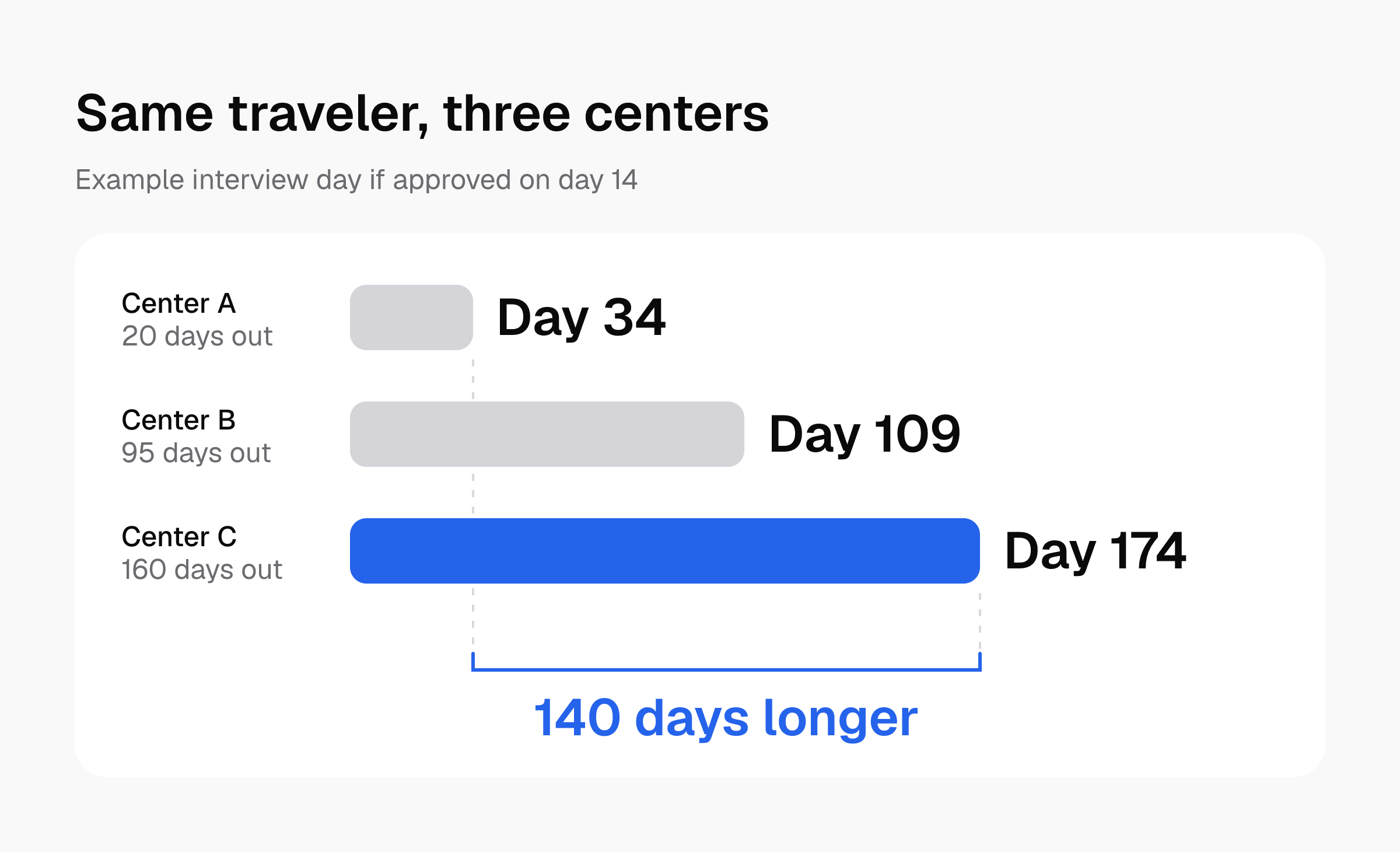
Take three centers in the same region. These gaps are invented to show the arithmetic, not current data:
| Center | Next bookable date (example) | Interview day if approved on day 14 |
|---|---|---|
| Center A | 20 days out | Day 34 |
| Center B | 95 days out | Day 109 |
| Center C | 160 days out | Day 174 |
In this example, the same traveler waits 140 days longer at Center C than at Center A. Check two or three centers on the availability page. A farther center with an earlier date can get you a PASSID months sooner, if the trip is workable. The site also has live wait-time pages for Global Entry, NEXUS and SENTRI centers.
One caution: the availability page shows each center's next bookable date. It does not show whether a slot is open right now. Treat the date as an estimate for planning.
Can you have both a KTN and a redress number?
Yes. They go in separate fields on a booking form, and the KTN gives you PreCheck lane access while the redress number addresses name mix-ups. Neither guarantees you will skip extra screening on a given trip.
Getting an earlier interview slot
If your center's next bookable date is months out, you can keep refreshing the availability page by hand. GlobalEntryTexts texts you when a Global Entry, NEXUS or SENTRI interview appointment opens at the enrollment centers you choose. Monitoring runs 24/7. You can watch up to 3 centers for the same price, texts are unlimited during the 30 days, and no account or login is needed to get alerts.
The limits are plain. It costs $25, paid once, for 30 days of monitoring; it is not a subscription. It is a website with no app to install, and alerts are SMS texts only. You book the appointment yourself on ttp.dhs.gov, because GlobalEntryTexts never books for you. A text is not a booking.
FAQ
Frequently Asked Questions
No. Neither number is required to book or fly. Most travelers have neither and leave both boxes blank.
Not reliably. If Secure Flight flags your name, Global Entry and TSA PreCheck will not prevent secondary screening. A redress case is the route for repeated name mix-ups.
Yes. A passport, or a Global Entry, NEXUS or SENTRI card, can serve as photo ID. Do not send Social Security cards or tax or financial documents.
DHS gives no fixed time, and review timelines vary. The number is assigned when you submit, but you cannot use it for reservations until the review ends.
Yes. Both names describe the 7-digit DHS TRIP number assigned when you submit the Traveler Inquiry Form.
Sources
- What is a Known Traveler Number (KTN)?
- What are a CBP PASSID and known traveler number?
- Step 1: Should I Use DHS TRIP?
- Step 3: Tracking Your Inquiry
- Redress Number: What Is It and Do I Need to Apply for One? [2026]
- Redress Number vs. Known Traveler Number - NerdWallet
- Where to Find Your Redress Number: TRIP Portal, Letter, or Airline - FedLaws