TWIC Known Traveler Number: Find Your CIN and Its Limits
There is no separate twic known traveler number: TWIC holders enter the Credential Identification Number (CIN) from the card in the airline's Known Traveler Number field, and that gets them TSA PreCheck at no extra cost. The CIN covers domestic PreCheck only, so it does not replace Global Entry, NEXUS or SENTRI.
If you are waiting months for a Global Entry interview, that means your domestic security line is probably already sorted. The interview stands between you and faster customs, nothing else. The rest of this page covers where the CIN is, who qualifies, a cost example with real fees, and how to shorten the wait.
How to enter your twic known traveler number
- Find the CIN. It is printed below the barcode on the lower left of the card back, and it is the first group of numbers there. Newer cards also have it embossed on the front. It is also printed on the letter the card was mailed with.
- Type it into the Known Traveler Number field when you book, or in the airline's profile page. Save it in every frequent-flyer profile you use.
- Match your name and date of birth. The name and date of birth on the reservation must exactly match the TWIC.
- Add it before check-in. USW Local 5000 notes it cannot be added once you are checked in.
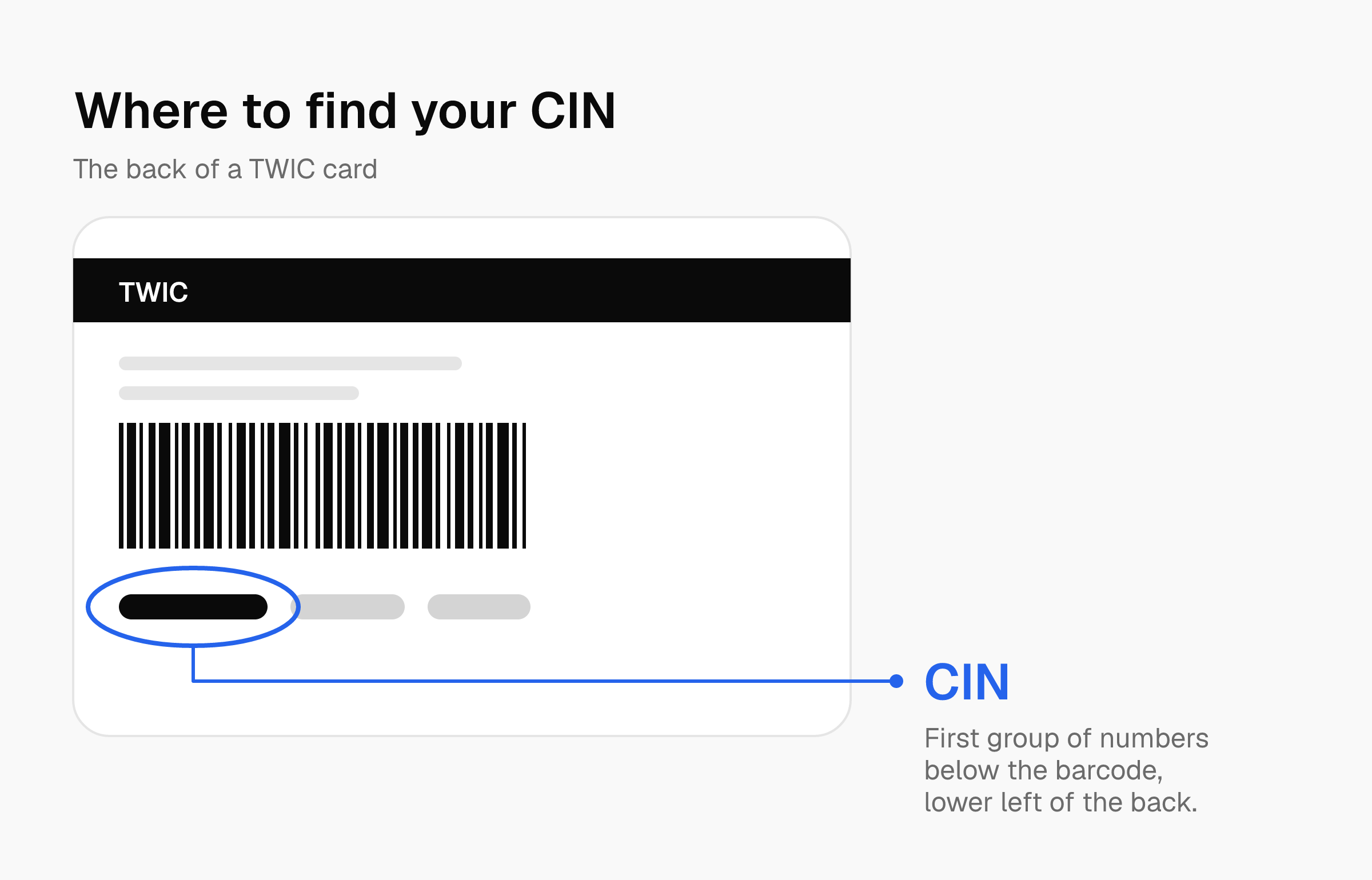
Some guides describe a labeled "KTN" field on the front of the card. TSA's FAQ says the CIN itself works as the KTN, so there is no second number to hunt for.
Who qualifies
- The TWIC must be active and not canceled.
- You must be a US citizen, US national or lawful permanent resident.
- The card must have been issued without a TSA waiver.
The benefit started April 15, 2020. TSA held off promoting it until June 2020 because of COVID.
Is a TWIC card the same as Global Entry or PreCheck?
TWIC costs $124 for 5 years ($93 reduced with an HME or FAST card). Renewal is $116 online or $124 in person. PreCheck through the CIN adds nothing to that. A standalone TSA PreCheck membership costs $78–$85 for 5 years, depending on the enrollment provider.
| Benefit | TWIC CIN | Global Entry ($120, 5 years) |
|---|---|---|
| TSA PreCheck at US airports | Yes | Yes |
| Global Entry kiosks when you return to the US | No | Yes |
The CIN also gives no NEXUS lanes into Canada and no SENTRI lanes at the Mexico border. Those are separate programs with their own applications. PreCheck does not help outside the US. The CBP application fee is $120 for Global Entry, NEXUS and SENTRI alike, since October 1, 2024, and each membership lasts 5 years.
Worked example: a port worker with a $124 TWIC
Say a port worker holds a TWIC that cost $124 and wants to skip the customs line when he flies home from abroad. He is thinking about Global Entry at $120.
- PreCheck: Already covered by the CIN. He pays $0 more for it.
- What Global Entry adds: Customs kiosks. The PreCheck part of Global Entry is a benefit he already has.
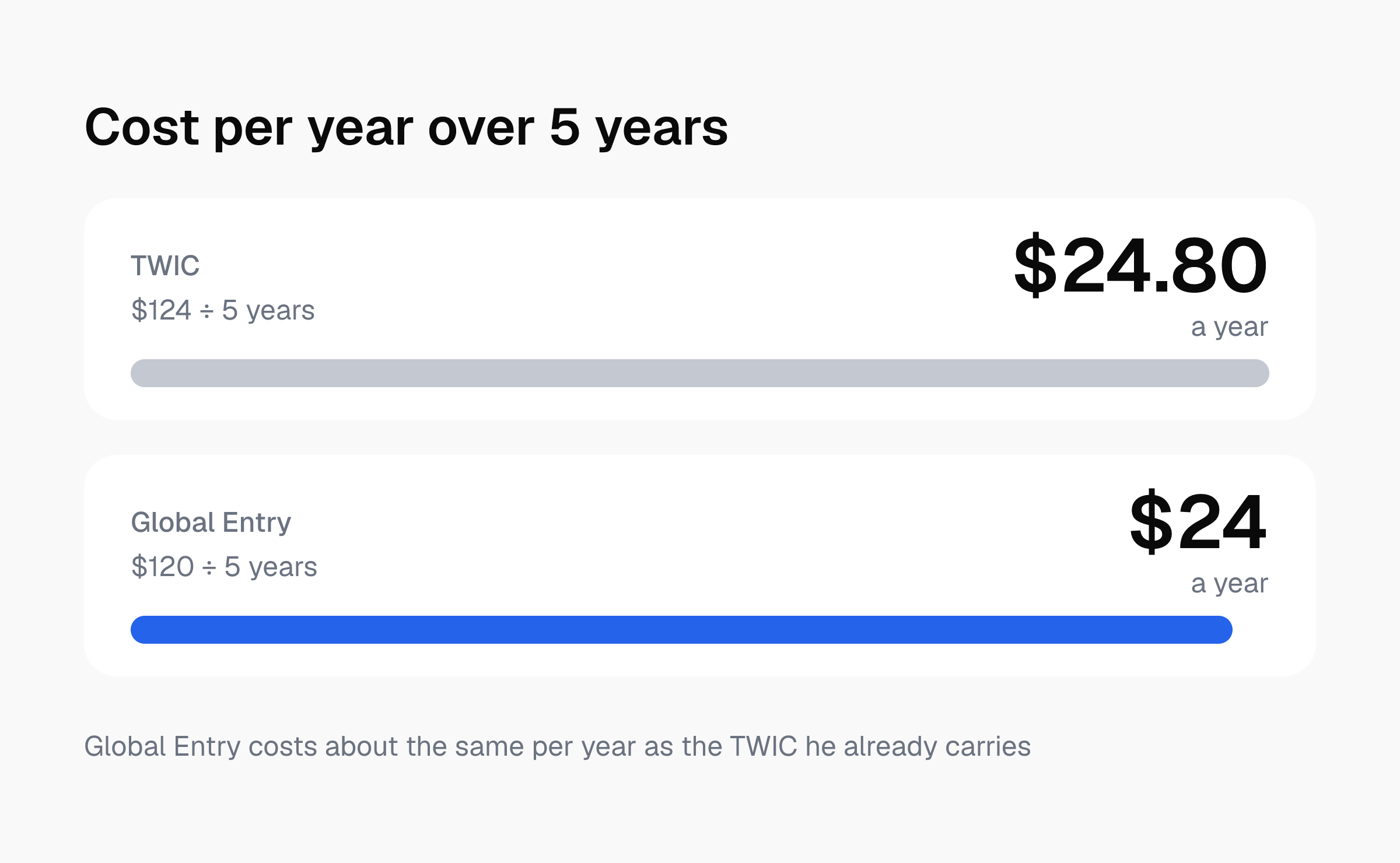
- Cost of that addition: $120 over 5 years is $24 a year. TWIC works out to $24.80 a year ($124 divided by 5), so Global Entry costs about the same per year as the card he already carries.
- Per return trip: If he flies back into the US 3 times a year, that is 15 returns in 5 years, or $8 per return. This is an illustration; you can use your own trip count in the site's free Global Entry cost per trip calculator.
PreCheck is already covered, so the decision for a TWIC holder is whether faster customs is worth $120.
While you wait for the interview
Capital One says conditional approval takes about 2 weeks for most applicants, though it can run 12–24 months if more review is needed. It also says most applicants get membership within 4–6 months, and that some locations are booked out for months. Your timing depends heavily on the center you pick. For how the stages add up, see Global Entry turnaround time.
- Check your center. The appointment availability page shows each center's next bookable date. Border commuters can use NEXUS wait times and the SENTRI wait-time page.
- Consider Enrollment on Arrival. With conditional approval, a passport and proof of residency, you can complete the interview at a participating airport when you return from abroad. CBP says doing so cancels any scheduled interview automatically. See Global Entry Enrollment on Arrival.
- Know your timeline. The Global Entry wait times by center page is a live wait-time page for Global Entry centers.
If you already hold Global Entry and are renewing, you can apply 1 year before expiry. Benefits continue for up to 24 months after expiry if you file before it lapses, and CBP says an interview may not be needed.
Hearing about earlier slots
GlobalEntryTexts texts you when a Global Entry, NEXUS or SENTRI interview appointment opens at the enrollment centers you choose. It costs $25, paid once, for 30 days of monitoring, and it is not a subscription. You can watch up to 3 enrollment centers in that window. You book the appointment yourself on ttp.dhs.gov; GlobalEntryTexts never books for you, because auto-booking would break the Trusted Traveler Program's terms.
FAQ
Frequently Asked Questions
No. TSA says the CIN cannot be looked up online. Check the back of the card, the front of newer cards, or the letter the card was mailed with.
Either works, according to the TSA FAQ. Use whichever you have saved in your airline profile, as long as your name and date of birth match it.
No. The CIN gives TSA PreCheck at US airports only. It gives no Global Entry kiosks on return, no NEXUS lanes into Canada and no SENTRI lanes.
The benefit started April 15, 2020. TSA held off promoting it until June 2020 because of COVID.
CBP says an interview may not be needed for renewal. You can apply 1 year before expiry, and benefits continue for up to 24 months after expiry if you file before it lapses.